
evergait™ Go is a prescription device for adults with uneven walking after stroke. Your clinic fits it and runs the first sessions. The patient continues at home, and every walk comes back to the therapist.
It brings the principle behind split-belt treadmill training to everyday walking, without the treadmill, and it is designed to fit inside a standard therapy visit.
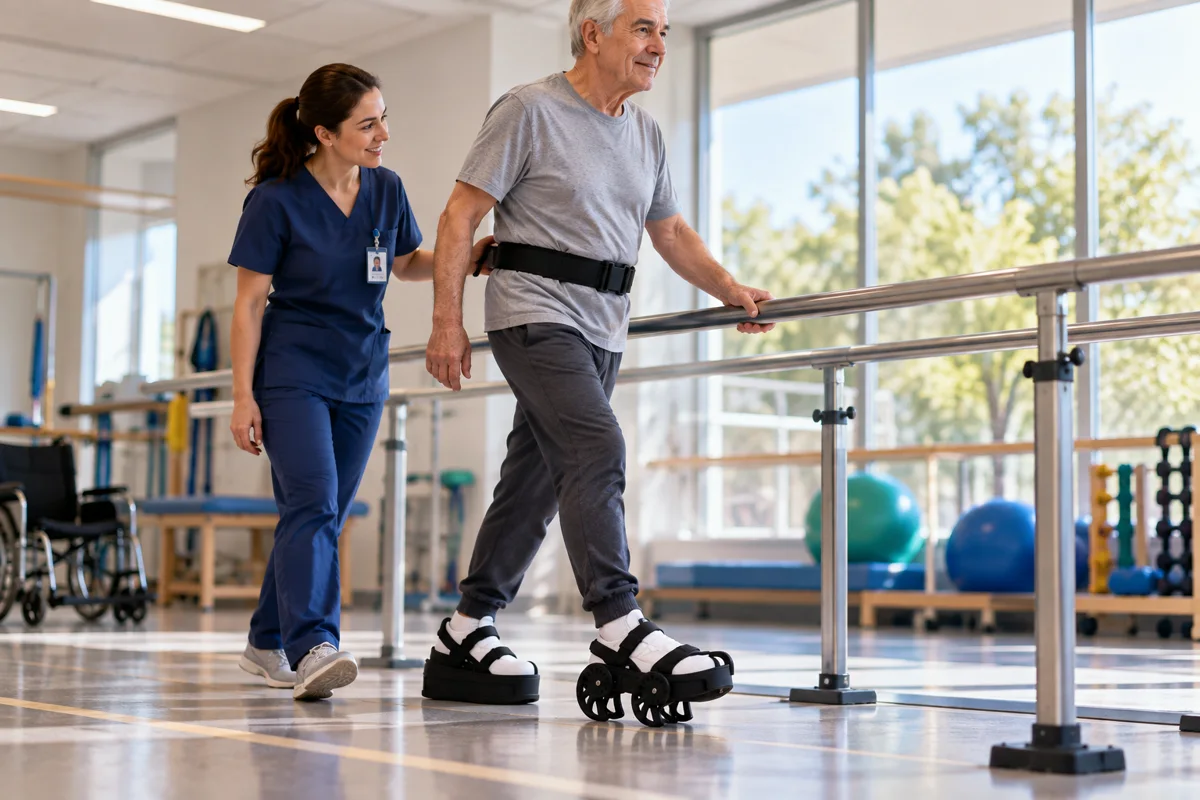
The clinic prescribes, fits and supervises. The patient keeps walking between visits, and the therapist sees each session.
A neurologist, physiatrist or therapist prescribes evergait™ Go for an adult with uneven walking after a stroke or another neurological condition.
The clinic fits the device over the patient's own shoe on the unaffected side, pairs the two motion sensors and sets the walking plan in the app.
The first walks happen in the clinic. Each session is up to 30 minutes of walking with rest breaks.
When the therapist decides the patient is ready, sessions continue at home on flat indoor surfaces, with a caregiver present for the first home sessions.
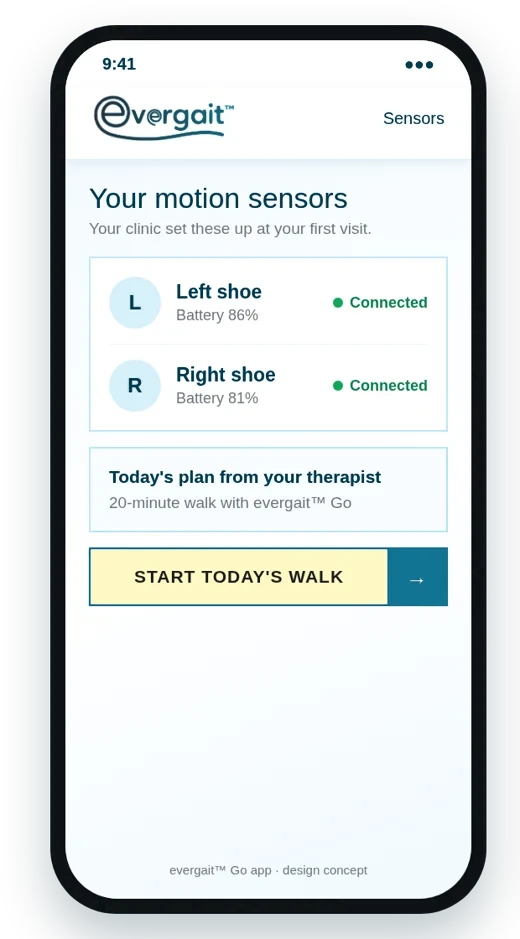
The sensors record steps and walking pattern. The app sends each session to the clinic so the therapist can review progress and adjust the plan.
The technology now known as evergait™ Go has been clinically evaluated: five peer-reviewed studies under previous names and implementations, including the Gait Enhancing Mobile Shoe (GEMS) and the iStride™ Device, in the clinic and at home.
| Study | Setting and participants | Reported results |
|---|---|---|
| Kim et al., 2019 J NeuroEng Rehabil | Clinic. 6 people more than a year after stroke. 12 sessions over 4 weeks, 30 minutes of walking each. | All six improved step length symmetry and all three functional measures (gait velocity, Timed Up and Go, 6-Minute Walk Test). |
| Huizenga et al., 2020 Top Stroke Rehabil | Home. 21 people more than a year after stroke. 12 sessions of 30 minutes. | Statistically significant improvement on all five outcome measures one week after treatment. 15 of 21 (71%) improved gait speed beyond the minimal clinically important difference. |
| Darcy et al., 2023 JMIR Form Res | Home, by telehealth with a care partner. 5 people. 3 months. | No serious adverse events. 95% of treatment sessions completed. Average improvement on each functional outcome exceeded the minimal clinically important difference or minimal detectable change. |
| Darcy et al., 2024 Front Neurol | Home. 18 people at least a year after stroke. 12 sessions of 30 minutes, followed for 12 months. | Average gait speed gain of more than 0.21 m/s at every follow-up through 12 months. 17 of 18 (94%) improved gait speed beyond the minimal clinically important difference at one or more follow-ups. |
| Darcy et al., 2025 JMIR Form Res | Home. 18 people with chronic stroke. 12 sessions of 30 minutes, followed for 12 months. | Improvements on the Berg Balance Scale, Timed Up and Go and Functional Gait Assessment remained statistically significant at every follow-up through 12 months. |
All five were single-group studies without a control group. They evaluated the technology now known as evergait™ Go under previous names and implementations, including the Gait Enhancing Mobile Shoe (GEMS) developed at USF and the iStride™ Device made by Moterum Technologies under a prior USF license, and most authors of the 2020 to 2025 papers were with Moterum. These are published research findings, not FDA-reviewed claims about safety or effectiveness. A controlled clinical trial of evergait™ Go, delivered in the clinic and then at home, is planned. Full research and publications →
Tell us about your clinic. We will contact you about availability, training and what we confirm on reimbursement.