
A prescription device for adults with uneven walking after stroke. The clinic sets it up, the patient continues at home, and every walk is shared with the therapist.
evergait™ Go brings the principle behind split-belt treadmill training to everyday walking, without the treadmill.
2026 Tampa Bay Inno Awards Honoree, Healthtech · Finalist, Emerging Tech Company of the Year, 2026 Tampa Bay Tech Awards18
Stroke is a leading cause of serious long-term disability in the United States, and it reduces mobility in more than half of stroke survivors age 65 and older.1 An estimated 9.4 million American adults report having had a stroke.2
Participants in the published home studies of this device were at least a year past their stroke and still walked unevenly when they enrolled (Huizenga 2020; Darcy 2024).
Split-belt treadmill training runs each leg at a different speed to retrain an uneven walk. The treadmill is fixed clinic equipment, and its benefits only partly carry over to walking on the ground (Huizenga 2020).
In a published study, 21 stroke survivors used the device at home for 12 sessions, and 81% could do the treatment without assistance by the end of week three (Huizenga 2020).
evergait™ Go is prescribed and set up by the patient's rehabilitation clinic, used in the clinic and then at home, and connected back to the therapist through the motion sensors and the phone app.
A neurologist, physiatrist or therapist prescribes evergait™ Go for an adult with uneven walking after a stroke or another neurological condition, typically six months or more after the stroke, who can walk on their own for at least 10 minutes with rest breaks.
At the first visit, the clinic fits the device over the patient's own shoe on the unaffected side, pairs the two motion sensors and sets up the app.
Each session is up to 30 minutes of walking with rest breaks. The published studies used 12 sessions, three a week for four weeks (Huizenga 2020).
When the therapist decides the patient is ready, sessions continue at home on flat indoor surfaces, with a caregiver present for the first home sessions.
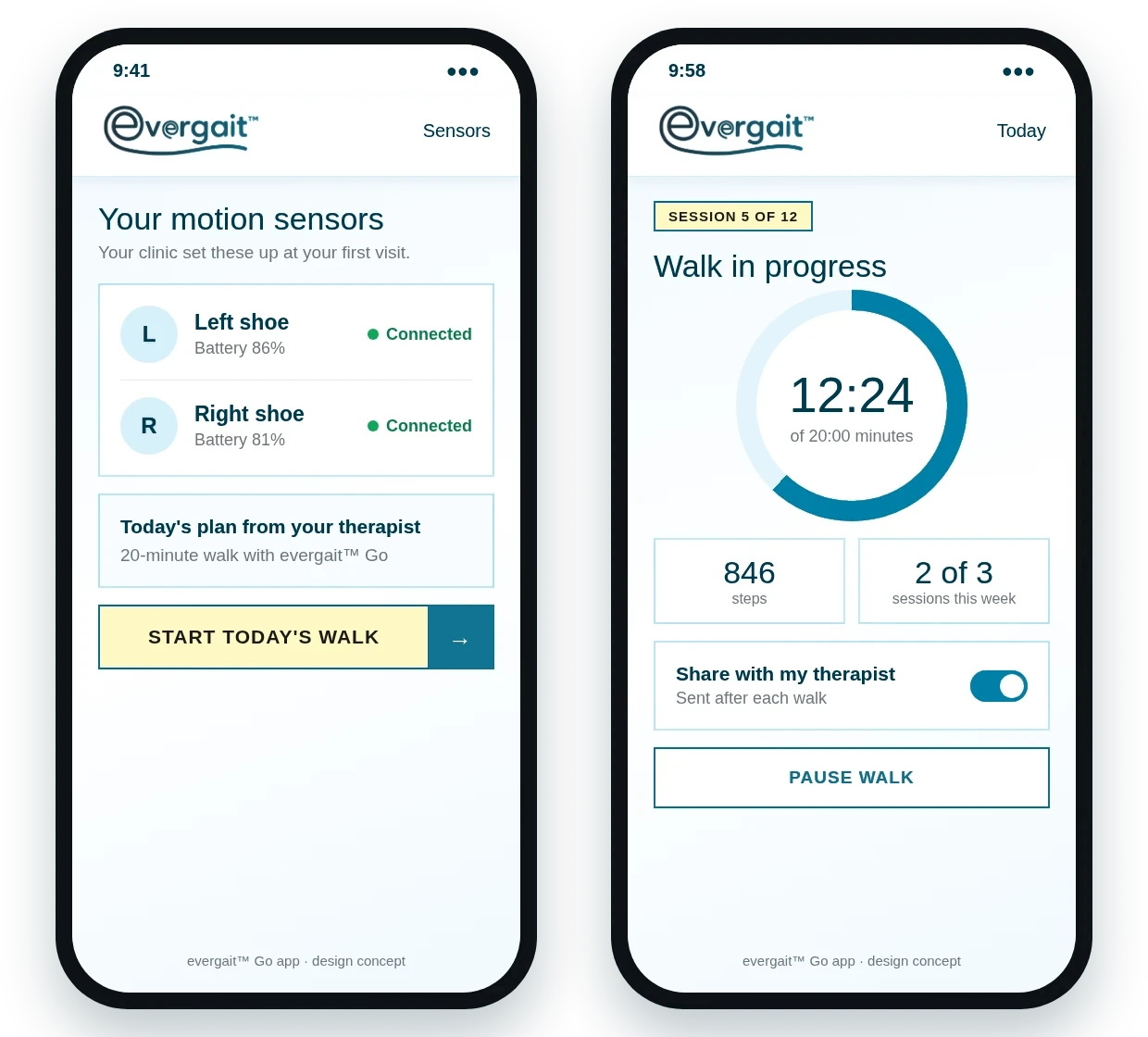
The sensors record steps and walking pattern, and the app sends each session to the clinic so the therapist can review progress and adjust the plan.
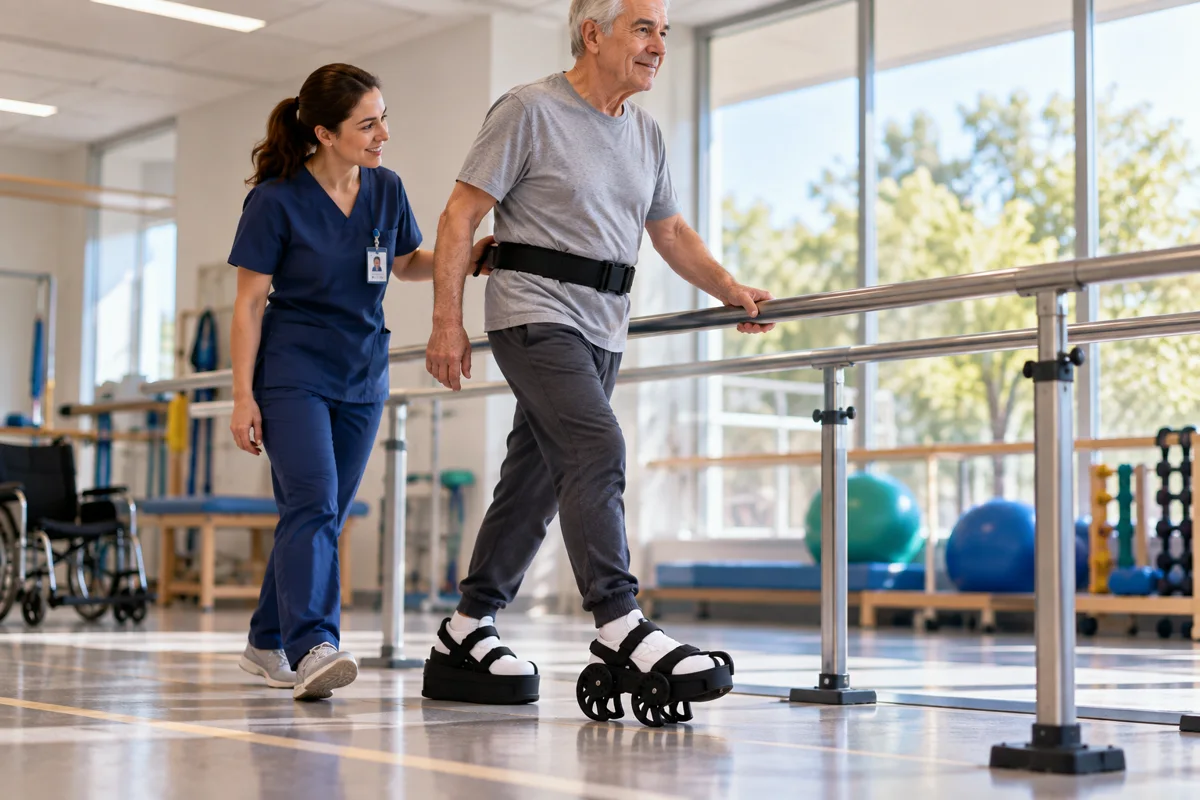
The clinic provides evergait™ Go and its motion sensors by prescription and runs the first session. The therapist sets the walking plan in the app, and the first walks are supervised.
It is designed to fit inside a standard physical therapy visit, with no dedicated room and no capital equipment. Information for clinics →
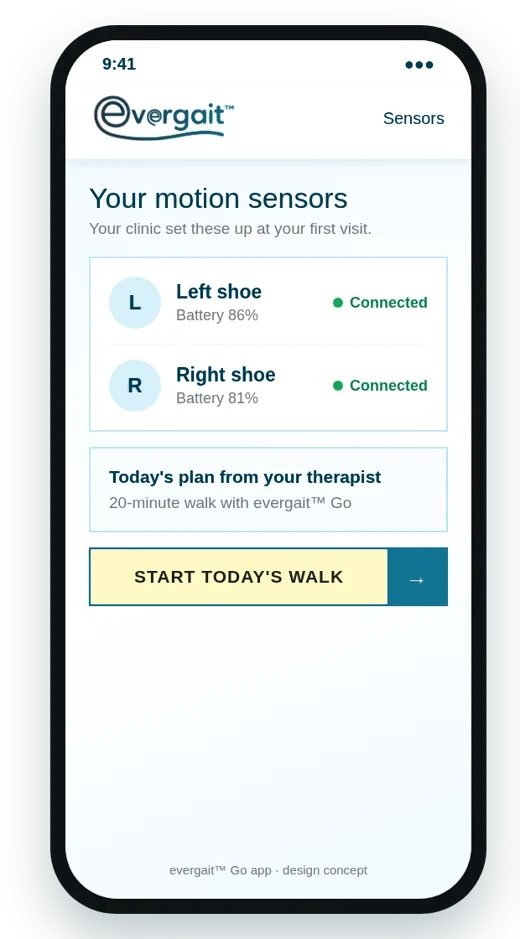
At home, the patient checks the sensors and starts today's walk. The app shows the therapist's plan, a session timer, the step count and the sessions completed this week.
After each walk the session is sent to the clinic. The clinician dashboard that receives it is in development.
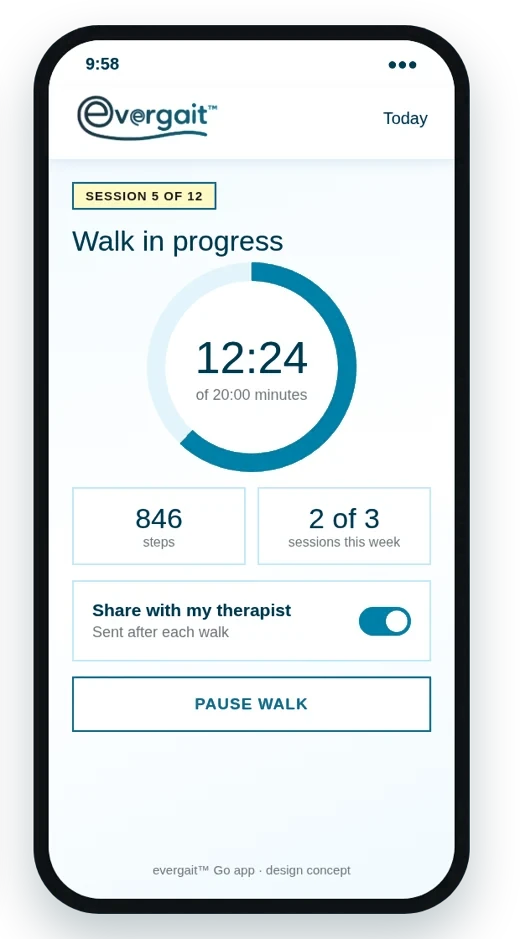
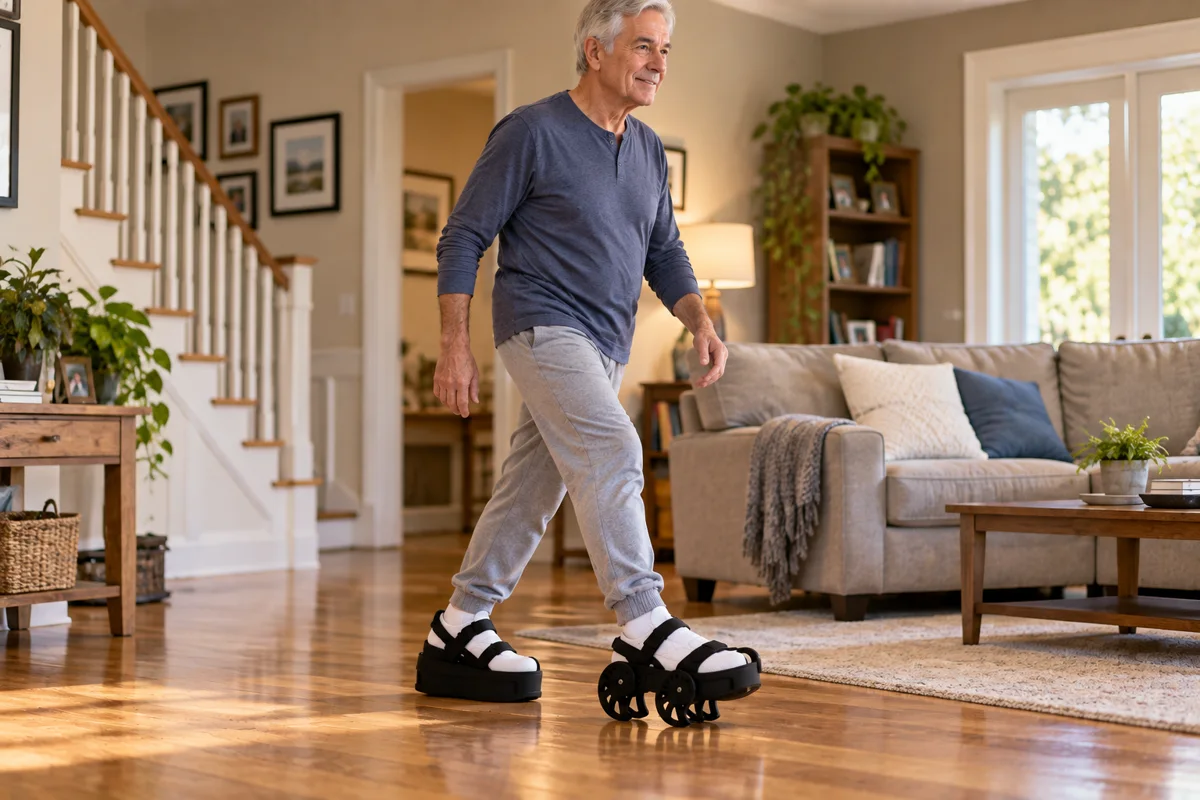
App screens are a design concept and may change before release. evergait™ Go is not yet available for sale.
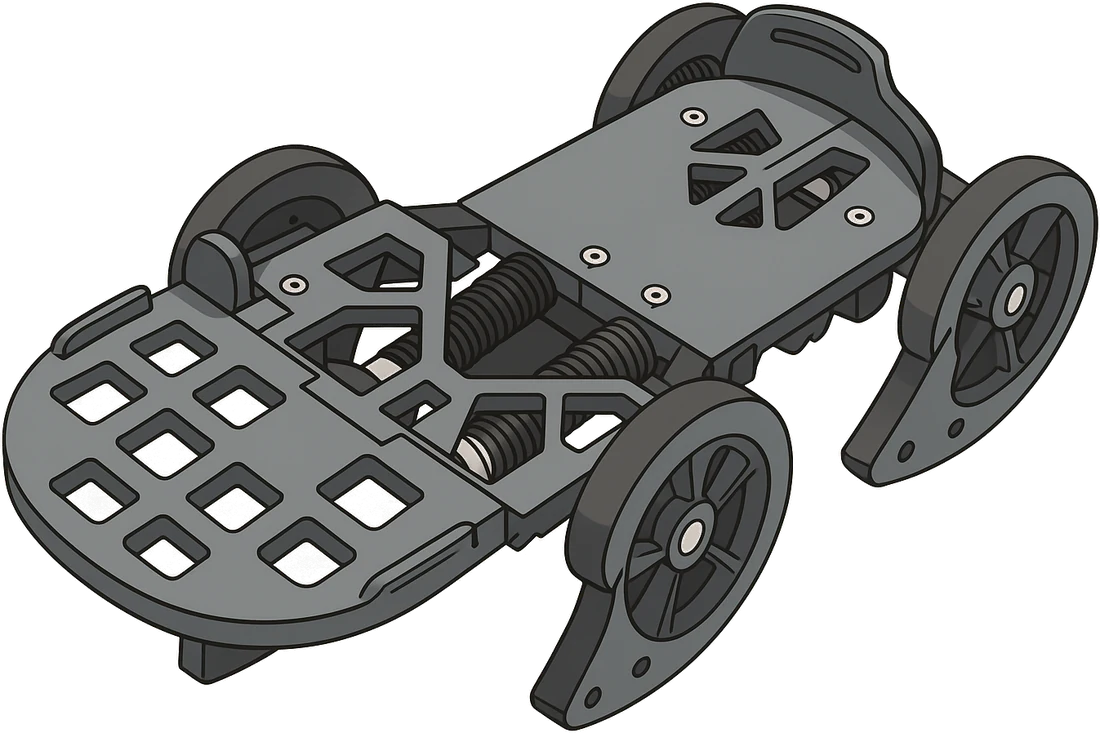
evergait™ Go brings the principle behind split-belt treadmill training to overground walking, without the treadmill. The attachment is fully mechanical, needs no batteries and fits in a standard bag.
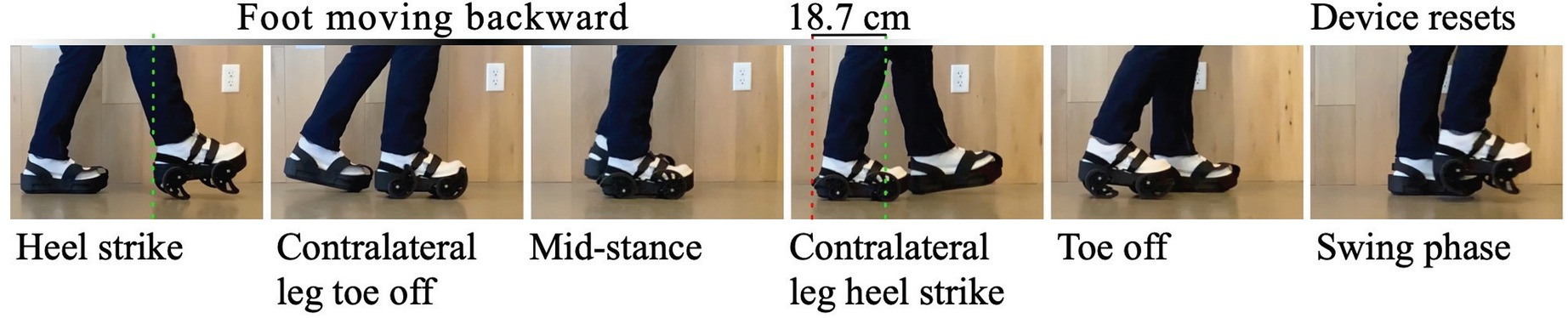
Four kinetic-shape wheels move the foot on the unaffected side backward during stance. This repeatable gait perturbation exaggerates the patient's existing asymmetry while the device is worn, engaging the processes associated with motor learning and gait adaptation.
Detailed research, mechanics, publications and videos at the USF REED Lab →For use in the clinic or at home
NIH funded, 8 peer-reviewed journal articles
Exclusive license from the University of South Florida
ISO 13485 contract manufacturer in discussion
Class II, 510(k) exempt3
evergait™ technology is exclusively licensed from the University of South Florida19: granted patents US 9,295,302,5 US 12,488,1546 and European Patent 3,104,7317 (Germany, France, United Kingdom), plus a pending U.S. continuation and a provisional application covering motion-sensor gait analysis. The first gait shoe was developed at USF's REED Lab with NIH funding.4
Research on this gait rehabilitation technology began at the University of South Florida (USF) in 2009 as the Gait Enhancing Mobile Shoe (GEMS) (de Groot 2009). USF licensed the technology to Moterum Technologies, which made it as the iStride™ Device;8 that license ended in 2025.19 evergait™ was formed in August 2025 and holds an exclusive license from the University of South Florida.19 With granted patents, published research and a written FDA classification,3 evergait™ is now focused on manufacturing, reimbursement and new clinical evidence.
• NIH funding: R21HD066200, Gait Enhancing Mobile Shoe for Rehabilitation, 2010 to 20124
• Published research: 8 journal articles, including one-year follow-ups on gait speed (Frontiers in Neurology, 2024) and balance (JMIR Formative Research, 2025)
• Patents: US 9,295,302,5 US 12,488,1546 and EP 3,104,7317
• Studies with stroke survivors: IRB-approved studies in the clinic (Kim 2019) and at home (Huizenga 2020; Darcy 2024)
• Next study: a controlled clinical trial, in the clinic and then at home, is planned
• Inventor: Dr. Kyle Reed, named inventor on at least 15 issued U.S. patents,12 has published on this device since 2009 and leads product development
• CEO: Diana Shapiro, Executive-in-Residence in the USF Ventures Launch Program,20 former COO of PeakLogic
• Medical advisor: Dr. David Z. Rose, vascular neurologist and Co-Director of the Neuro-ICU at Tampa General Hospital21
• FDA counsel: prepared the 513(g) request that led to FDA's 09/03/2026 response3
• Need: about 9.4 million US adults report having had a stroke,2 and stroke reduces mobility in more than half of survivors age 65 and older1
• Delivery: prescription only, provided by rehabilitation clinics, which set it up with the patient at a first in-clinic session
• Manufacturing: contract manufacturer in discussion; quality system to be in place before launch
Research at USF's REED Lab, first funded by NIH in 2010,4 with published pilot, feasibility and follow-up studies in stroke survivors. The technology now known as evergait™ Go has been clinically evaluated. Earlier studies evaluated the same gait rehabilitation technology under previous names and implementations, including the Gait Enhancing Mobile Shoe (GEMS) and the iStride™ Device, made by Moterum Technologies under a prior USF license.8
53-year-old stroke survivor participating in IRB-approved research study at USF REED Lab
Participant provided informed consent for research documentation. Video from IRB-approved clinical study.
Research Context: This documentation is from an IRB-approved research study. evergait™ Go is not yet available for sale. Results shown are from controlled research settings and individual outcomes may vary.
Results below are from IRB-approved research studies conducted with informed consent under controlled research conditions. Individual results may vary. These are research findings, not FDA-reviewed claims about safety or effectiveness.
| Study | Setting and participants | Reported results |
|---|---|---|
| Kim et al., 2019 J NeuroEng Rehabil | Clinic. 6 people more than a year after stroke. 12 sessions over 4 weeks, 30 minutes of walking each. | All six improved step length symmetry and all three functional measures (gait velocity, Timed Up and Go, 6-Minute Walk Test). |
| Huizenga et al., 2020 Top Stroke Rehabil | Home. 21 people more than a year after stroke. 12 sessions of 30 minutes. | Statistically significant improvement on all five outcome measures one week after treatment. 15 of 21 (71%) improved gait speed beyond the minimal clinically important difference. |
| Darcy et al., 2023 JMIR Form Res | Home, by telehealth with a care partner. 5 people. 3 months. | No serious adverse events. 95% of treatment sessions completed. Average improvement on each functional outcome exceeded the minimal clinically important difference or minimal detectable change. |
| Darcy et al., 2024 Front Neurol | Home. 18 people at least a year after stroke. 12 sessions of 30 minutes, followed for 12 months. | Average gait speed gain of more than 0.21 m/s at every follow-up through 12 months. 17 of 18 (94%) improved gait speed beyond the minimal clinically important difference at one or more follow-ups. |
| Darcy et al., 2025 JMIR Form Res | Home. 18 people with chronic stroke. 12 sessions of 30 minutes, followed for 12 months. | Improvements on the Berg Balance Scale, Timed Up and Go and Functional Gait Assessment remained statistically significant at every follow-up through 12 months. |
All five were single-group studies without a control group. They evaluated the technology now known as evergait™ Go under previous names and implementations, including the Gait Enhancing Mobile Shoe (GEMS) developed at USF and the iStride™ Device made by Moterum Technologies under a prior USF license,8 and most authors of the 2020 to 2025 papers were with Moterum. These are published research findings, not FDA-reviewed claims about safety or effectiveness.
Next: a controlled clinical trial of evergait™ Go in chronic stroke, delivered in the clinic and then at home, with comfortable walking speed as the primary measure, is planned.
21 publications on the device and its kinetic-shape wheels: 8 peer-reviewed journal articles, 5 conference papers and 8 conference abstracts. Each links to the publisher's record.
Detailed mechanics, videos and the lab's full publication list: USF REED Lab evergait Research Page →
Where evergait™ stands today, and what comes next before launch.
✓ NIH-funded research from 2010, REED Lab, USF4
✓ 8 peer-reviewed journal articles, 2011 to 2025 (list)
✓ Granted patents exclusively licensed from the University of South Florida: US 9,295,302, US 12,488,154, EP 3,104,73119
✓ FDA 513(g) response received 09/03/20263
• Class II device type, exempt from 510(k) premarket notification (21 CFR 890.5360)3
• Manufacturing and quality arrangement with a contract manufacturer, in discussion
• Quality system in place before launch
• Registration, listing and labeling under 21 CFR Parts 807 and 801
• Post-market surveillance plan
• First clinics in Florida
• Reimbursement analysis for Medicare
• Distribution through rehabilitation clinics and durable medical equipment channels
• New clinical evidence from a controlled clinical trial, in the clinic and then at home
The inventor of the technology, who has published on it since 2009, a CEO who has led technology companies, and a stroke neurologist as medical advisor.



Regulatory Counsel: FDA regulatory counsel prepared the 513(g) request that led to FDA's 09/03/2026 response.3
Manufacturing: An ISO 13485 contract manufacturer is in discussion. The quality system will be in place before launch.
R&D Collaboration: Ongoing collaboration with USF REED Lab including graduate student researchers and undergraduate engineering teams supporting product development and testing.
evergait™ is funded so far by non-dilutive awards and is applying for federal small business research grants.
University of South Florida: exclusive license to the university's patents19
Non-Dilutive Awards: USF Foundation Bull Ring Accelerator Grant (2025) and Florida High Tech Corridor Early Stage Innovation Fund (2026)
Federal Research Grants: applying for SBIR/STTR funding for clinical studies and product development
Clinical Partners: rehabilitation clinics for the first prescriptions and for new clinical data
Numbered citations on this page link here. Studies are cited by author and year and link to the Publications list above.
evergait™ Go will be available by prescription. The prescribing clinic provides the device and its motion sensors and sets them up with the patient at a first in-clinic session. It is intended for adults with uneven walking after a stroke or another neurological condition, typically six months or more after the stroke, who can walk on their own for at least 10 minutes with rest breaks. Join the list and we will contact you when it is available.
Whether you're a healthcare provider interested in learning more, a researcher exploring collaboration, or a potential partner, we'd like to hear from you.
We welcome inquiries from healthcare providers, researchers, and potential collaborators interested in learning more about evergait™ technology. evergait™ Go will be available by prescription. Rehabilitation clinics and patients can join the waiting list using the waiting list form above or by emailing [email protected].
Founder & Chief Technology Officer
Associate Dean for Undergraduate Affairs, College of Engineering; Professor, Mechanical & Aerospace Engineering, University of South Florida
Email: [email protected]
USF Email: [email protected]
Technical partnerships, research collaborations
Chief Executive Officer | Executive-in-Residence, USF Ventures
Email: [email protected]
USF Email: [email protected]
Business inquiries, strategic partnerships
evergait, LLC
Florida limited liability company
802 E. Whiting Street
Tampa, FL 33602
Website: www.evergait.com
FDA classification: On 09/03/2026, responding to a request under Section 513(g) of the Federal Food, Drug, and Cosmetic Act,
FDA advised that evergait™ Go falls within 21 CFR 890.5360, Measuring Exercise Equipment (product code ISD), a Class II device type
exempt from 510(k) premarket notification, subject to the limitations in 21 CFR 890.9. A 513(g) response is FDA's view of how a device
is classified. It is not FDA clearance or approval, and evergait™ Go remains subject to FDA requirements, including registration and listing,
labeling, and the Quality Management System Regulation.
Availability: evergait™ Go is not yet available for sale. Today it is used only in research studies conducted under IRB approval
with informed consent. When available, it will be prescription only. Rehabilitation clinics and patients can
join the waiting list.
About this website: Information on this website describes evergait and its research. It is not medical advice.
Talk with your healthcare provider about your own care.